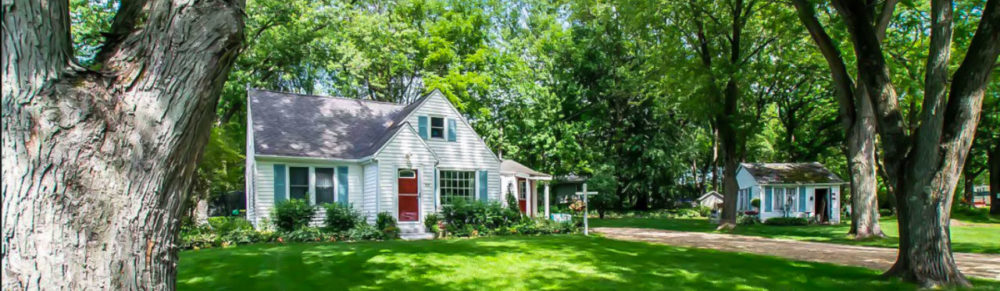
Every success story is built on a strong foundation. This the underlying basis for everything in the real world; it establishes permanence; and it is the lowest, and most important, load bearing part of a structure. Without a solid and strong foundation, a thing cannot exist for long.
In the case of my cabin, more than 100 years on a wooden foundation sitting directly on the soil was taking its toll. Every time I came back from the west coast I would notice new cracks in some of the windows. My initial thought was that people were somehow to blame for the broken glass, but it wasn’t as if they were broken by rocks or some kind of impact, and I soon realized that as the ground would freeze and thaw, or simply get saturated with rain, the building would shift slightly, and the old glass would just crack as their frames slowly twisted under the pressure of Mother Nature. The old building was crying for help.

At the same time I was under pressure from a different type of force. The nearby town, in whose Ward my property sits, was sending me notices that my cabin was in a dilapidated state, and had to be brought up to safe standards, or torn down within a certain time frame. The county, on the other hand, was refusing to give me a permit to do any work on the building. Time and pressure can be mighty forces when working together: a long amount of time and an immense amount of pressure can turn coal into a diamond. In my case, the pressure I was getting from the town was working in opposition to the amount of time I was wasting trying to convince the county that my cabin was significant and worthy of saving, and with those forces working against each other I could see that the outcome was potentially disastrous. Since the forces of mankind were currently working against me, I decided that something had to be done to give the cabin more time if it were to have a fighting chance, and so I developed a plan to put a solid foundation under it, and stop the cabins decay at the hands of Mother Nature.
There has always been for me an extremely satisfying feeling to look at a problem, come up with a solution for, and implement it, no matter how difficult or scary it may seem. Putting a foundation underneath this frail old cabin was certainly that: I would have to somehow pour a solid concrete footing underneath the walls of the standing building without destroying the integrity of the structure or any of it’s beautiful old cedar siding. Which meant, of course, I would have to lift the building straight up off of it’s crumbling wood floor from the inside, dig trenches under the walls, pour the concrete, and then set the building back down onto the cured concrete in one piece. This did involve some research and math which I won’t go into here, but I’ll mention now that I do have some Engineering experience, so I would have to caution against doing something of this magnitude on the basis of “I believe this can work”. The “Hold My Beer” school of thought is not something I tend to lean into, so my confidence that I could make this work did have some grounding in experience, science and physics.
My solution to raise the cabin off of the ground involved building an internal framework that I would bolt to the existing wall studs inside the cabin. This would keep the structure solid and intact and allow the entire weight of the cabin to transfer into 2 triple beam supports that would run across the cabin and allow me to jack up the building from the inside. But before I could do all of that, I had discovered that a Robin had flown into the cabin through one of the holes in the roof, built a nest up in the roof joists and laid 3 perfect eggs. Once again, time and nature had conspired against me in my race to save Lockwood’s last cabin.

The American Robin is not only the State bird of Wisconsin, they are protected under the Bird Migratory Treaty Act and so there was nothing for me to do but wait. But it wouldn’t be too long; Robin eggs gestate for about 2 weeks, and then it’s only about as long before the chicks leave the nest. In the bigger sense, the cabin had lasted for over 100 years and I didn’t feel that a few more weeks were going to matter. Fortunately it was spring and the weather was beautiful and Wisconsin is such a lovely place to hike, enjoy nature and of course, take advantage of Lake Geneva, the second most beautiful lake in the United States according to Travel and Leisure Magazine.
Once my tiny squatter issue was resolved, I began the process of securing the old Cabin on a new, strong footing. I did this by bolting 2×10 boards to the wall studs, and then created the 2 triple beams, also out of 2×10 boards, that would attach under the frame, pushing on the frame and not the walls of the cabin, thereby transferring the entire weight of the building evenly across the beams and onto the jacks. Once that was all built, I placed four 2-ton hydraulic jacks under the triple beams, took a deep breath and started to slowly inch the building up, one jack at a time. When I started to see daylight underneath the bottom plates of the cabin I knew we were on the right path to saving the old structure.


I kept jacking, and building safety pylons out of 4×4 lumber along the way until the building was about 18” off the ground. That gave me just enough room to excavate the dirt under the walls to allow for the pouring of a 12” wide, 12” deep concrete footing to serve as the permanent new beginning for Lockwood’s Last Cabin.
Now you may be thinking, if I can do all of that work without a permit, why not just continue forward? Technically, that work; pouring a relatively small amount of concrete, amounted to less than 100 square feet of construction, and by code, did not require any type of permit or dispensation from the County or local Building Department. And so now I had bought some time for the structure as it would no longer continue to twist and creak into a slow, sad ending. We slapped some new paint on the siding as a kind of victory dance, but the holes in the roof still presented a problem for the town, and though the cabin was no longer decaying, it would still need some major renovation work, and that could only start once I convince the County to change it’s mind. A feat I severely underestimated…
Stay tuned for the next installment of this old cabin…