Sowing Seeds of Tourism

The Farmer Who Brought Visitors to Williams Bay a Century Ago

One hundred years ago, nestled among the rolling hills and sparkling waters of Williams Bay, a humble farmer made a decision that would help shape the town’s identity as a beloved retreat for generations to come. While others tilled the soil strictly for crops, Ulyses S Lockwood, a local farmer, chose to cultivate something different: a sense of wonder.

It was the early 1900s, and Lake Geneva was still a well-kept secret outside of the Chicago elite who visited seasonally. Ulyses, who had spent his life working the land passed down from his father, recognized that the real wealth of the area wasn’t just in the soil—it was in the scenic charm of the lake, the peaceful woods, and the gentle pace of rural life.

The Cottages That Changed Everything

Original Cabin at Serenity
The original Cabin Christmas

Instead of planting another round of corn on a small section of his property just north of the lake, Ulyses made a bold move. He cleared the land and, with the help of local carpenters, constructed a few tiny cottages—simple wood-frame structures with wide windows to catch the breeze off Geneva Lake, each with it’s own outhouse.

Word spread quickly.

What started as a quiet experiment soon became a local sensation. Visitors from Chicago, Milwaukee, and even as far as St. Louis came looking for a “country escape” with modern comforts. Families would stay for a weekend or a week, fishing on the lake by day and sharing stories by firelight at night. Some returned year after year, drawn not only by the lake’s natural beauty but also by the genuine warmth of their host.

Ulyses didn’t see himself as a hotelier or an entrepreneur. “I’m just a farmer who likes people,” he was known to say, often seen chatting with guests while handing out fresh eggs or sharing vegetables from his garden.

Planting the Roots of Lake Geneva Tourism

Unintentionally, Ulyses Lockwood had created one of the first destination lodgings in the Lake Geneva area outside the resort-style hotels of the city’s wealthier districts. His cottages inspired others—neighboring farmers followed suit, converting barns or building small cabins to welcome tourists.

Within a few decades, the area began to transform. Restaurants, bait shops, and boat rental businesses sprang up. Seasonal tourism became a central part of the local economy, and Lake Geneva’s reputation grew from a hidden gem to a Midwest treasure.

By the time Lockwood passed away in the 1950s, his small enclave of cabins had started to evolve into larger homes, or just be demolished to make way for other versions. His last original cottage—weathered and in dire need of repair—remained, serving as a quiet reminder of a visionary who saw the land not only for what it could produce, but for how it could be shared.

A Legacy That Endures

Today, the Lake Geneva area is a thriving destination, hosting tens of thousands of visitors annually. Yet, among the bustling lakefront and luxury accommodations, the spirit of Ulyses Lockwoods’ hospitality endures. The last of his cottages still stands on the property now known as Serenity and remains as a symbol of how one farmer’s simple idea helped sow the seeds of a community built on beauty, welcome, and rest.

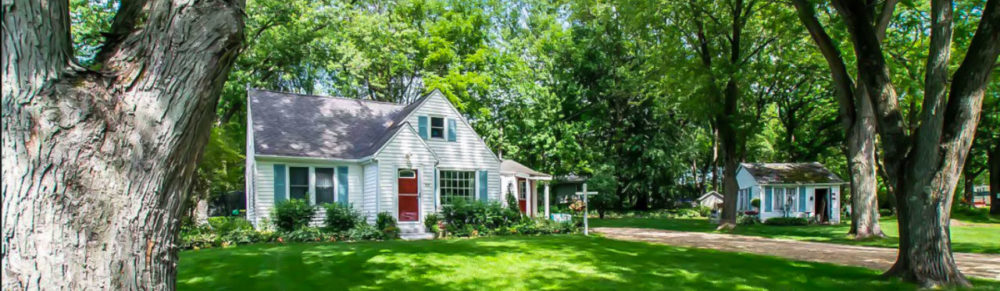
It is in the spirit of this legacy that I’ve begun the transformation of Lockwood’s Last Cabin from a crumbling earthen floor cabin with gaping holes in the roof, and rotting doors and windows, into what will be a more modern tiny house with indoor plumbing and modern creature comforts.

In a world driven by big developments and flashy attractions, U.S. Lockwood’s legacy reminds us that sometimes, the best way to grow something meaningful is to make space for others to simply enjoy what’s already there.

Read about how the journey started in the next post

Where It All Started

When I first bought this property I knew I was going to do something with the small cabin, I just didn’t know what yet. I knew nothing about it but I knew it had some potential… some reason to continue on even though it was in pretty bad shape. The paint was peeling badly, in desperate need of scraping and re-coating, the roof had large holes, and where there weren’t holes there was a thick layer of moss, the ancient steel gutters were rusted and leaking, and mostly filled with it’s own ecosystem of lichen and small trees that had started growing out of the detritus that had built up in them. Everyone told me I should just tear it down and build something new. My home owner insurer, and I won’t say who that was at the time for reasons that are about to become clear, told me that should the tiny cabin accidentally burn down, they would give me $20k for it. But I was unmoved, and maybe that has something to do with my love for all things classic, or my mad desire to fix things rather than throw them out, or the hubris that I can always make things better than they currently are. Whatever the reason, I simply had no intention of destroying the cabin.

I took ownership of the house and moved right into preparing the main house to be a short tern rental as I was still living and working in Los Angeles at the time. The cabin became a place to store camping and water sports equipment while it otherwise remained neglected and continued to degrade. When I would come back occasionally from California I would notice new cracks in the windows of the cabin, and I thought some mischievous person was playing around it and breaking the windows. What I soon came to realize was that the structure, being as it was simply floating on the ground, was slowly sinking unevenly into the earth causing the walls to twist and warp, and hence crack the windows as it settled into a twisted mess.

And then the letters started to appear. Every couple of months I would receive official correspondence from the neighboring town of Delavan, telling me that my cabin is dilapidated and needed to be either fixed and brought up to safe standards, or torn down. This came as a huge surprise to me since I was under the impression my property was on unincorporated land. It turns out my property is in a ward of Delavan and they claim rights to our infrastructure, as bare as it is, and hence seem to have the right to tell us what to do with the structures on our properties. Even more surprising is that as I travel around the area I pass by dozens of other buildings, crumbling farm structures, old walls holding up caved in roofs that are in far worse shape, looking like they should have collapsed long ago, things that seem to be standing sideways just as a mockery to the strong winds we get across the open farmland, and yet no one seems to want to condemn those structures.

Nonetheless, this began the process of looking into options to save the cabin, and trying to get the permits to do the work. The process of getting to that starting point would take more than 18 months, and several thousands of dollars just to get the right to spend tens of thousands more to actually commence construction, this due to the insistence of the county that my structure was “just a shed” that I was trying to convert into a living space, something they had a problem with for some reason.

Now at this point, I still had no idea what this cabin was doing there in the first place. I did not know the history of it, how old it was, nor why it had been abandoned in the first place. I spoke with the neighbors who had only vague guesses and rumors about it, but what was becoming clear was that my cabin was not the only one that had existed in my small enclave. For a fact, two others had been nearby but both had been expanded well beyond their tiny footprints into larger houses which two of my neighbors were currently living in. These homes looked absolutely nothing like my cabin. One of the other cabins had simply become the walls of the kitchen for my neighbors Rick and Debbie’s house, and the other had turned into the more sprawling ranch style home of Vera, a firecracker of a 90-year-old lady and the first neighbor I met after closing on my house. There is no way to tell that either of these homes could have ever been a tiny 200 square foot cabin. And apparently there were several others which had been demolished decades earlier to make way for newer, larger homes. But still no one had a clear idea how they got here in the first place.

One theory was that they used to be fishing cabins down by the lake, and that they had been moved up the hill to our little area many many years ago to make way for the larger palatial homes that had staked out the lakefront. A theory which I thought was far fetched. So I decided to start my own investigation which proved difficult as there were few resources from the history of a very rural Wisconsin lake area that only really started to become relevant when wealthy industrialists started to build grand homes along the lake front, and then all of that history was about them and their castles. And then one day I wandered into the Lake Geneva library and started talking to one of the librarians, who also had no clue what those cabins had been doing there or why I would even care for that matter. But then she had a thought and recommended I talk to one of the other librarians who did have some research knowledge of the area, and that’s when I met Keith Gerlach the Facility and Technology Librarian of the Lake Geneva Library. He took an interest and told me to give him a few days to research the plats from the area at the turn of the century to see who had owned the land my property currently sits on. Enter Ulysses S Lockwood.

U. Lockwood is making preparations for a tourists' camp on his farm at Williams Bay
Lake Geneva News, March 10, 1927
Lake Geneva News, November 10, 1927
Lake Geneva News, September 13, 1928

The Lockwood Tourist Camp would operate for more than a decade before the land was divided up into the individual properties that currently make up Lockwood Estates.