
One of my all time favorite pastimes is auto racing. I love watching and photographing open wheel racing, F1 and Indy car, sports cars and even drift cars. I’m not so much a fan of NASCAR though I did build and race a short track stock car in my late teens. We can chalk that one up to the wisdom of youth. As a teen with a license to drive, and living in a Chicago suburb, around May every year some friends and I would talk about driving down to Indianapolis for The Greatest Spectacle In Racing, the Indy 500. And a couple of times we actually did. And it was spectacular. When I moved to Southern California it became a yearly tradition to spend a long weekend every June in Long Beach where they turn the streets of the downtown area into one of the most exciting race tracks in the world. For three days i would attend the Long Beach Grand Prix with my good friend Drew.
Drew lives in Northern California so we rarely get to see each other outside of race weekends, but we generally get in a great deal of conversation over those few days. He is even more of a race fan than I am, and has a pretty sweet race car that he takes to some of the tracks that dot the deserts and coastlines of California. Drew is also an architect. Ah, finally back to the story at hand. Outside of talking about the gear head things that guys talk about on race weekends, we also talk a lot about architecture, and at some point at the beginning of my cabin journey we were talking about permits. Having no experience in this area I had no idea that there were different kinds of permits that were handled by different municipal agencies, and so Drew’s expertise was surely being exploited by me. At one point we were talking about the relationship between the permit seeker and the municipality, and he mentioned that it is often a necessary meeting of two minds at odds with one another. And then he told me that he is the only architect in his size-able firm who generally gets his permits without much friction. That is because, he said, most of the other architects go into the process thinking they have all the answers, and view the permit office as a hostile entity that ought to bend to their needs, whereas Drew generally shows up with coffee and donuts.
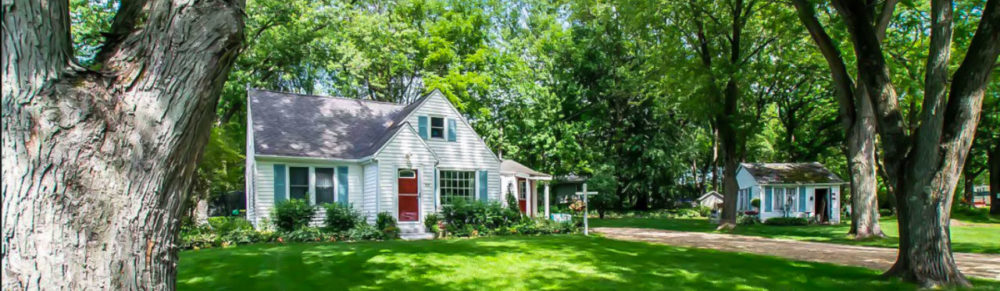
What I thought to be my first step in this process was to visit the town building inspector, and long before I pulled out a hammer or stomped a shovel into the ground around my cabin, I had a conversation about the scope and plan for renovating my cabin with him. The conversation was optimistic considering the size of the project, he felt it would not be a problem securing building permits, however I would have to start with the county in order to get an okay for any zoning considerations, especially concerning septic. So off I went in search of a zoning permit application to the County of Walworth, WI.
The form is a 1-page document with some fairly rudimentary questions outside of the identifying information such as exact location, footage, and plat information. I filled out the form as honestly and carefully as I could, giving as much information about my objectives as the form had room for. It seemed like a simple process. It was summarily rejected by the county.

To have the wind drop out of your sails just as you are pulling away from the dock is disheartening. This was the very first step in the process, I had not yet actually done the work to put the foundation under the cabin, it was still in disrepair and in danger of losing it’s ability to exist, and I was being denied the permissions to save it. Here was the first indication that this was not going to be the easy project I had somehow dreamed up in my head. I couldn’t do whatever I wanted to on my property, there were considerations and approvals. There were other people’s involvement. Any plan I had to start work had suddenly evaporated, and it was just about time for me to return to the west coast and other obligations. I would have to try and deal with this remotely.
I started with a phone call, as the rejection to my application did not come with much in the way of explanation. When I got the woman in charge on the phone and asked why the application was rejected, she said you cannot turn a shed into a habitable structure.
I wanted to make sure I heard that correctly and asked for clarification. “You want to turn a shed into a habitable structure. You cannot do that,” she said. I explained that the structure in question is not a shed, but an old cabin, in fact it is a cabin with historic significance to the lake Geneva area. I simply wanted to renovate it back into better shape and preserve its history. “So you want to take a shed and make it into a cabin.”
I asked her to please stop referring to the cabin as a shed but that seemed to fall on deaf ears and misunderstanding was quickly turning into exasperation on my part. She did say that I could always apply again, which did little to make me think the next time would have a different outcome. Later I was sifting through my files about the project as I considered my next move when I came across the last survey of my property which was made in the 1980’s, and it clearly showed the location of my house, a small box which I could only assume was the old outhouse that used to be there prior to the modern septic system, and the square which represents the location of the cabin, in the center of which the word “shed” had been hand lettered into.
Sometimes an “aha!” Moment can be staring you in the face but for whatever reason you’re just not getting it. I did realize now why she referred to the cabin as a shed for obviously the surveyor who was likely no longer around was far more knowledgeable about that structure than I, the mind at odds with her way of seeing the situation. There had to be a way for me to convince her that the old survey was wrong and I thought about that for a couple of weeks. How do I change her mind when she has empirical evidence that supports her way of thinking.
Aha! Finally it hit me: All I had to do was get a new survey done which clearly labeled the cabin as what it really is. I hired a survey company and they set out to remeasure my property and create a new survey with all of the property boundaries, structures and setbacks and, per my instruction, clearly labeled the cabin as an historic cabin. This was sure to change everything, and I felt the permit was practically in my hands.
It changed nothing. Again, the permit application was denied.
Dejected, rejected, helpless. I felt I needed to speak with someone who had some expertise in zoning laws and dealing with just this sort of thing, so I sought out a real estate attorney and found one who had some amazing insight. It turns out this particular attorney had experience with the very county permit administrator I was currently dealing with, explained to me just what was happening, and how I should go about changing the application to fit what it was I really wanted to do. Minor changes, she insisted which would have a great impact as to how my project was being looked at by the county.
Meanwhile, another drama was unfolding just across the border in Illinois. I have another architect who has been a friend since our college years and I’ve always liked his forward thinking and eco-friendly view of designing residences, and when I had asked him a year prior if he would be interested in coming up with a design for the cabin that fit all of my criteria, I was shocked when he said “sure!” His design is beautiful, as you will eventually see, but at this point in time he had gotten a concern that his approval on the drawings might not be valid in Wisconsin as he was licensed in Illinois, and so he had his assistant call the county to ask if he needed to be licensed in Wisconsin. As fate would have it, the assistant somehow got through to the very woman I had been sparring with, and when she asked which property was the assistant referring to, he told her my address. Her response was “Oh, he’s not building anything there!”
I was furious when my friend told me that because it sounded as if she had a vendetta against me. What had I done to make her mad at me to a point she would use her power against me? But I had to rise above all of that because I realized it was simply my force of the need to renovate this old cabin butting up against her unmovable need to adhere to county code, and now, not only did I have the new survey, but I also came armed with the resources of a real estate attorney who had guided me in the ways of properly filling out the permit. My new empirical evidence coupled with the verbal jui jitsu of a real estate attorney was going to win the day, and I assured my architect/friend that we were going to build this project. And I filed the 3rd round of permit application to the county.
It was denied for a third time.

I stood with the letter in my shaking hand. Again I felt this was personal. And I felt this had to only be addressed head on. I called the county office to make an appointment with the permit woman and press my case face to face. They gave me a time for the very next day at 10 am. I immediately took to pen and paper to start writing my response to the continual denial. It started; “how dare you?” I continued by asking why she would tell my architect that I wouldn’t be building anything on my property, and why was she seemingly singling me out… I was seething and venom was leaking from my pen onto the paper. The rage was just building and I was certain that somehow this was the way I was going to win this case.
At that moment, as if on cue, the words of my friend Drew came slamming back into my head with the power of a wisdom that stops a rational person from doing the irrational. “All the other Architects go into the office with an axe to grind. I go with coffee and donuts.”
I dropped my pen, tore up the paper and threw it into the trash.
The next morning I arrived at the meeting and met the county permit woman for the first time. She looked as if she was expecting a fight from me. I did not bring coffee nor donuts, but I did come with a vision. I smiled and introduced myself and then went into why I started the cabin renovation project in the first place. I told her about the history of the place, and I laid out my vision of what I intend the place to be. And then I asked her how she could help me realize that vision. To her credit, she pulled out the plans I had sent and explained to me exactly why the project had been denied. We talked about it and found 2 compromises that would allow her to issue me the permits I needed to move forward. I walked out of that office on a cloud.
A week later, County Permit in hand, I walked into the town building department and got the permits I needed to actually start the renovation and restoration of Lockwoods’ Last Cabin.
Stay tuned as the fun is just beginning.